Deflationary Abundance: A New Framework for AI-Induced Macroeconomic Disequilibrium
Conceptual Paper
Deflationary Abundance: A New Framework for AI-Induced Macroeconomic Disequilibrium
When technology drives supply toward infinity and demand collapses
By Avigdor Adler
Key Points
Definition: Deflationary Abundance is an economic condition in which automation (notably AI) drives marginal production costs toward zero, expanding supply almost without limit while simultaneously eroding labor incomes and collapsing effective demand.
Mechanism: AI flattens the supply curve (near-infinite output at negligible cost); displaced or deskilled workers reduce consumption at every price point, shifting the demand curve inward.
Result: A chronic overproduction regime: lower prices with too few buyers—an equilibrium-breaker unlike standard productivity booms.
Evidence Preview: Recent deflationary pressures in China illustrate how weak demand and excess capacity can co-exist, foreshadowing the broader AI dynamic.
Policy Pivot: Without redistribution (e.g., UBI/AI dividends, wage subsidies, public goods), demand may hug the axis; with redistribution, equilibrium can be restored.
Abstract
The emergence of large-scale artificial intelligence introduces an unprecedented economic paradox—Deflationary Abundance—where technological productivity drives supply toward infinity while simultaneously collapsing effective demand through wage erosion. This conceptual paper defines the term, situates it within the literature on deflation, overproduction, and technological unemployment, and presents stylized supply–demand dynamics that can produce chronic overproduction despite falling prices. A brief case discussion of recent deflationary pressures in China illustrates the fragility of demand when confidence and incomes weaken. The paper concludes with policy options that can restore equilibrium by reconstituting purchasing power in an era of near-zero marginal costs.
Keywords/Tags: AI economics; deflation; automation; effective demand; overproduction; technological unemployment; redistribution; macroeconomic disequilibrium.
JEL Codes (suggested): E31, E24, O33, O40.
- Introduction
Artificial intelligence enables the mass production of cognitive services at near-zero marginal cost. Tasks once requiring years of training—writing, analysis, coding, customer support—can be replicated indefinitely by software agents. In classical terms, the supply curve for a broad class of goods and services is flattening and shifting outward. Yet the same technology that expands supply also erodes labor incomes, collapsing effective demand. This paper proposes a formal label for this regime—Deflationary Abundance—and outlines its implications for macroeconomic stability. - Definition
Deflationary Abundance. A macroeconomic condition in which automation drives the marginal cost of production and service provision toward zero, dramatically expanding supply, while simultaneously eroding aggregate labor income, thereby collapsing effective demand and producing chronic overproduction despite falling prices. - Relation to Existing Literature
The idea intersects several established strands: Keynesian effective demand and demand shortfalls; technological unemployment and skill-biased technical change; Schumpeterian creative destruction; and modern work on inequality and the labor share of income. Deflationary Abundance differs by positing a simultaneous limit case—near-infinite supply coincident with structurally weakened demand—creating persistent disequilibrium even without monetary contraction. - Stylized Mechanism and Diagrams
Three stylized panels illustrate the transition from equilibrium to abundance to deflationary abundance:
• Baseline: Downward-sloping demand and upward-sloping supply intersect at a normal equilibrium.
• AI Abundance: Supply flattens toward horizontal as marginal cost approaches zero.
• Deflationary Abundance: Demand shifts inward (income erosion, precautionary saving), potentially becoming near-vertical at low quantities. Overproduction and price declines coexist with insufficient absorption.
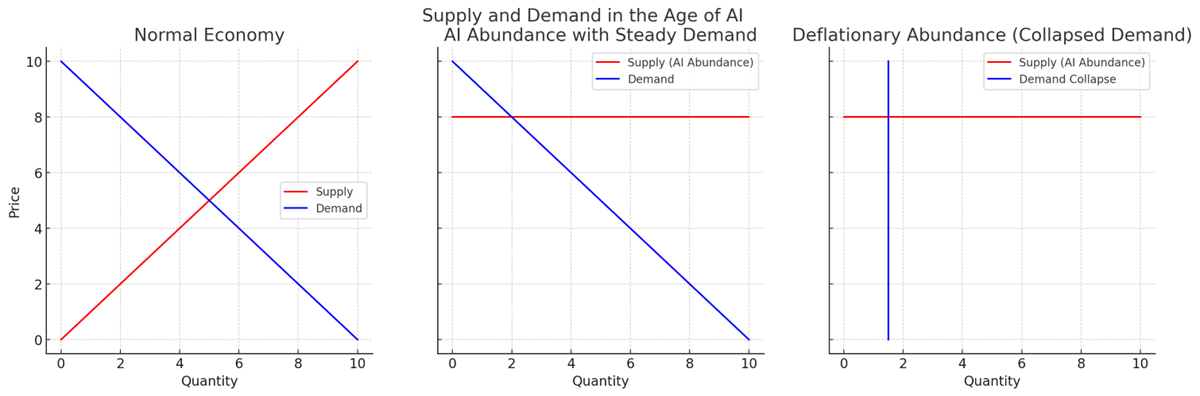
Figure 1. Three versions of supply and demand under AI. The right panel illustrates Deflationary Abundance—abundant supply with collapsed demand.
- Case Discussion: China’s Recent Deflationary Pressures
Recent years have seen episodes in China where producer prices and the GDP deflator declined amid excess capacity, weak household confidence, and precautionary saving. While not an AI-driven limit case, this pattern illustrates how cheap goods do not guarantee robust demand when incomes and expectations weaken.
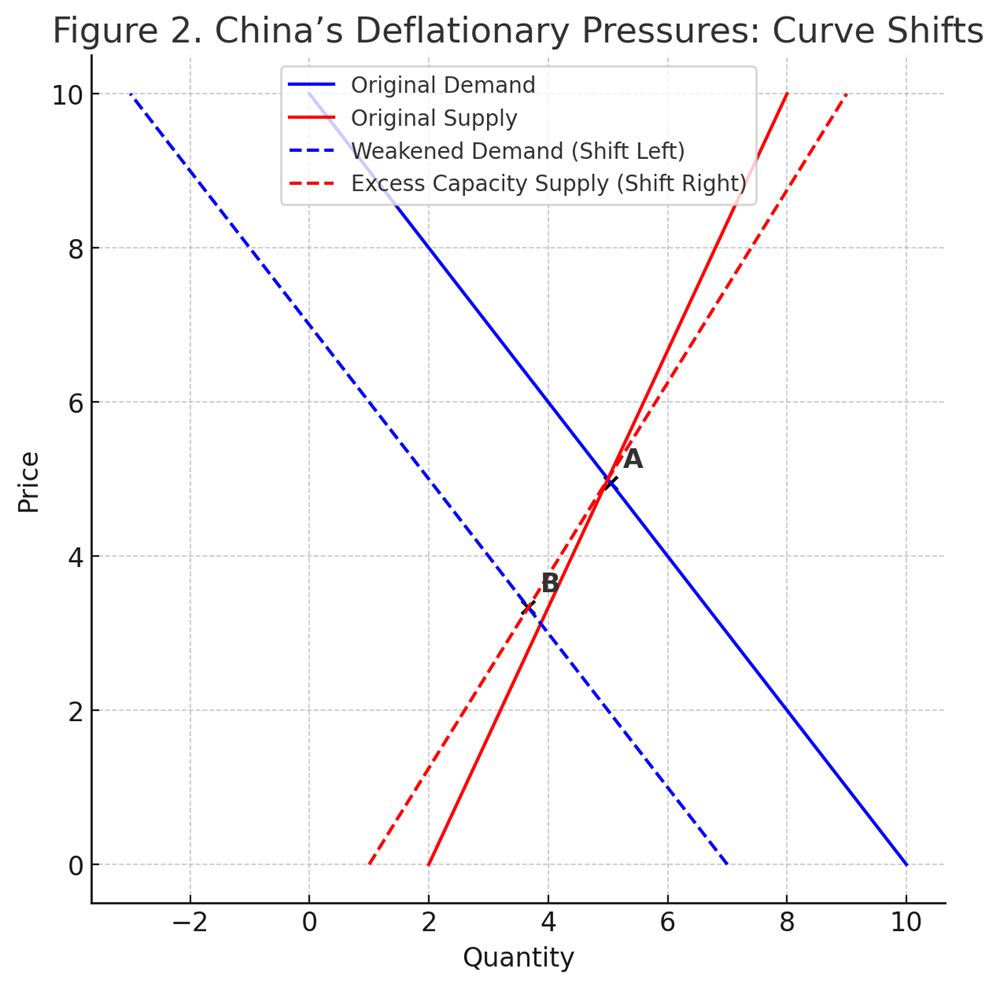
Figure 2. China’s deflationary pressures: supply shifts right (capacity), demand shifts left (weak confidence), moving equilibrium from A (higher prices/quantities) to B (lower prices/quantities).
- Policy Implications
The distinction between abundance and collapse hinges on distribution. If productivity gains accrue narrowly to capital owners, demand may “hug the axis.” If redistributed—via instruments such as universal basic income, AI dividends, wage subsidies, or expanded public goods—purchasing power can be reconstituted and equilibrium restored. In effect, policy becomes the pivot that determines whether Deflationary Abundance yields prosperity or stagnation. - Conclusion
AI’s capacity to compress marginal costs forces a reconsideration of equilibrium assumptions. The framework of Deflationary Abundance highlights a plausible regime of persistent overproduction with inadequate demand. Recognizing and naming this state enables clearer policy design to restore effective demand in a world where supply is no longer scarce.
References (select)
OECD (2019). OECD Employment Outlook 2019: The Future of Work. OECD Publishing.
McKinsey Global Institute (2023). Generative AI and the future of work. McKinsey & Company.
Keynes, J. M. (1936). The General Theory of Employment, Interest and Money. Macmillan.
Schumpeter, J. A. (1942). Capitalism, Socialism, and Democracy. Harper.
Note: References illustrative; align final citations with the data and sources used in the manuscript.
Author
Avigdor Adler holds a B.Sc. in Electrical Engineering (Technion), a B.A. in Social Sciences (Open University of Israel), and an M.B.A. in Finance (University of Haifa). He writes at the intersection of technology, economics, and society.